I’m not long back from my first Wedding Show in three years.
Before the covid pandemic, a small group of local ministers shared being present at one of the wedding fairs that took place in our town. Always on a Sunday afternoon, the one who was closest (me) took responsibility for setting up and for being the first one there in the afternoon. Then others would appear as worship finished and lunch was eaten, and a rota of being able to wander the stalls, and even go to the loo, happened.
Local colleagues have changed, presbytery has changed, and some of us are theologically different from others, and so latterly I have been on my own – supported by congregation members who pop by to bring lunch or chat to the table visitors while I visit the facilities.
Today it was clear that people were surprised that the church was being represented, and people asked on a number of occasions why I was there. I’ve rehearsed the answers a few times today, and I’m hoping that the answers might be helpful to others who are thinking about whether or not they should represent their local church at a wedding fair.
- Should the church be represented at a wedding fair? I think we should. The church is meant to be wherever people are, and joining in the celebrations. It is an opportunity to encourage people to explore how celebrations speak to the spiritual sense of belonging. If we choose not to be there, what does it suggest to others? Are we encouraging others to see us as an elitist group, who just expect people to appear? By being present, do we have an opportunity to discover what matters to couples and respond to that?
- But church wedding services are all the same? It is possible to find liturgies or copies of wedding services and read them and that might make you think they are all the same. But for many ministers, these liturgies are frameworks to help shape a ceremony that is unique to each couple. No two couples are the same. They come with different ways of meeting and growing together, and different hopes for the future, so in some way this will be reflected in a ceremony.
- We would have to have hymns or organ music? You don’t, but you might want to think about what will make your wedding unique to you. No music is possible, but there are also opportunities to have something different. In my experience, I’ve conducted weddings with no music, recorded music, keyboards, harps, live musicians, orchestras, Tonganese singing, ukuleles, and flutes and clarinets. Sometimes there are reasons why certain things don’t work in certain buildings, but never be afraid to ask.
- You wouldn’t marry someone like me! Not sure why not. The Christian faith I represent speaks of love, welcome and inclusivity.
- Ministers only marry people in church buildings. Some might not be keen to go elsewhere, but it is worth asking a minister. I am one that doesn’t mind being elsewhere, and am delighted to be asked. I’m maybe not so keen on sky-diving, or snorkelling, or on a climbing wall, but if I can reasonably get there and stand with my feet on the ground I am happy to help.
At today’s wedding fair there were at least five celebrants there. Wedding fairs are often where couples who are just beginning to think about what a wedding might look like head for ideas. So they leave with cards and freebies that start them thinking, and that includes thinking about who will help them shape the promises they will make to one another. For me that means it is important that the church is there.
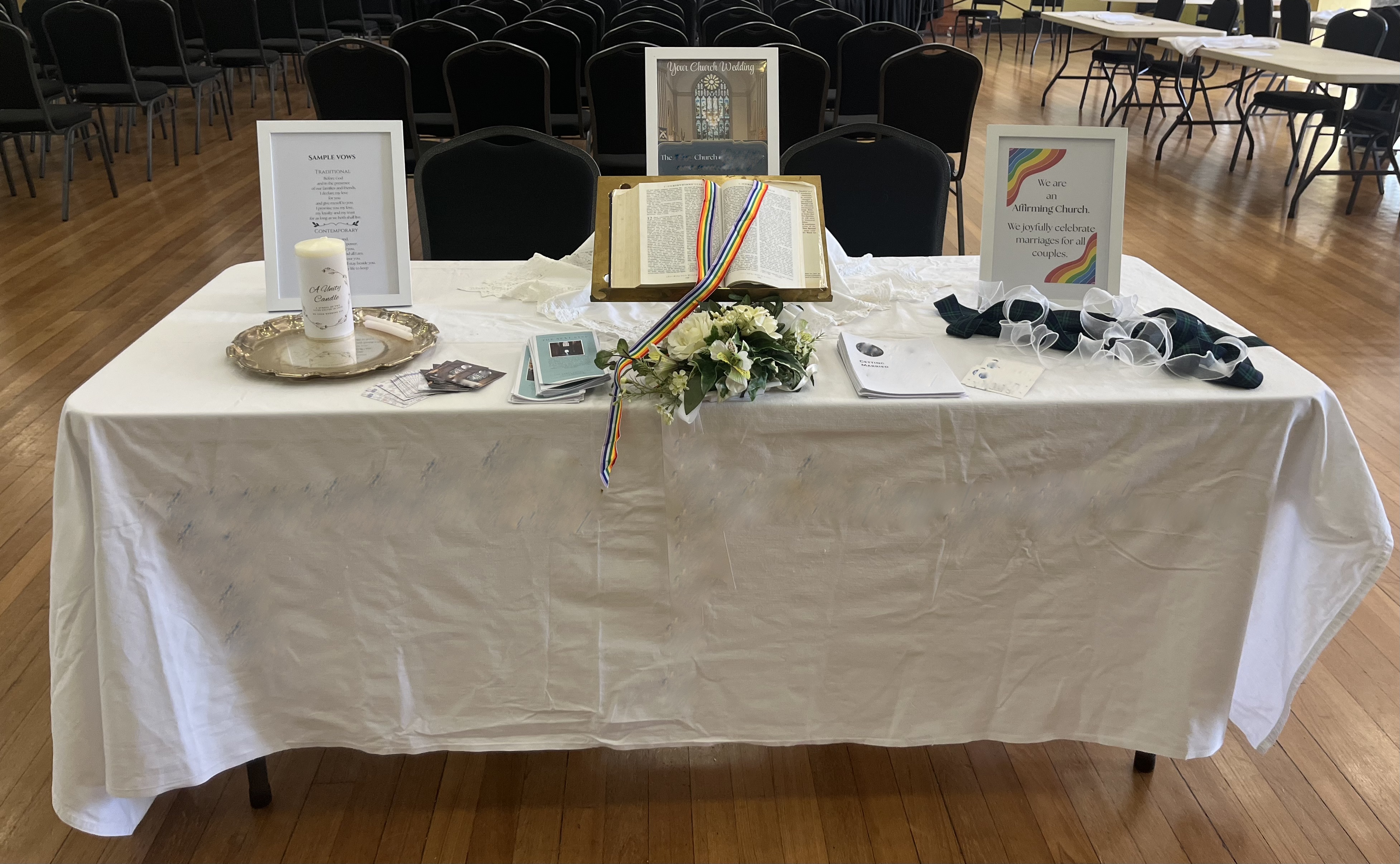
My set up is nothing fancy, and easily shared with others who might be thinking that they should think about being at a local wedding show. I have three white frames – one saying who we are, another stating that we are an affirming congregation (we are working on making that official), and the last offers a sample of traditional and contemporary vows. A Bible sits on a table lectern open at 1 Corinthians 13 (of course!). Because weddings I have done have used symbols like hand fasting and unity candles, these and some flowers are also on the table. And of course we have leaflets, letting people know what a church wedding might involve. The business cards are my own and the church, with the Apache Wedding Prayer on the back.
Of course a wedding fair is an opportunity to look for ideas that might find its way into future ceremonies, and today I noticed the layering of sand – and I thought of families where that might have been useful as they blended their stories together.
I’ve looked at the organisers plan for the next wedding shows and there are no more at the venue this year. But perhaps I should follow the example of a colleague and plan one of our own in our own building, so that there is an opportunity for people to to discover that they are welcome.
 Beachblesser's Blog
I love this idea and your answers to the questions!